
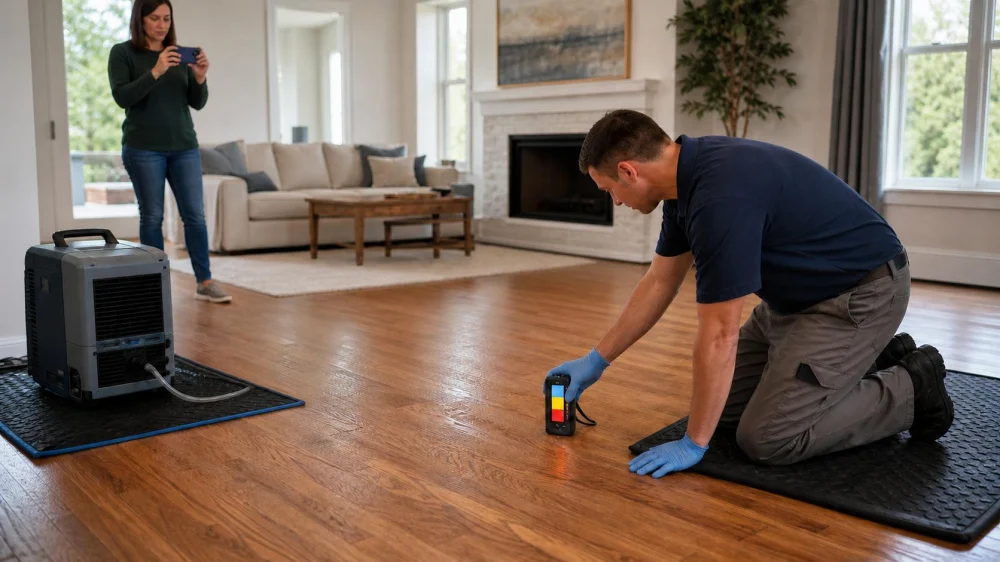
Water on Hardwood Floors: Dry the Assembly, Not Just the Top
A hardwood surface can look dry while moisture remains between boards, in adhesive, underlayment, or the subfloor. Fast action matters, but uncontrolled heat and premature sanding can make damage worse. Stop the source, address electrical and contamination hazards, remove standing water safely, document the floor, and use moisture measurements to guide drying and repair.
Quick answer
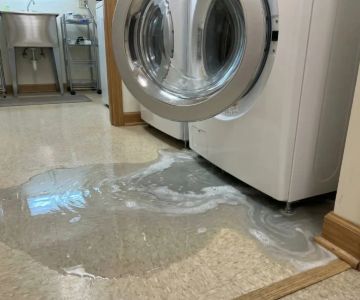
Stop the leak if it can be done safely and keep people away from water near electricity. Extract or blot standing clean water without flooding adjacent areas. Photograph the room and note how long the floor was wet. Call restoration and flooring professionals early when water spread under boards, came from a contaminated source, or affects a large area. Do not apply concentrated heat, sand a cupped floor immediately, or assume dry-looking boards mean the subfloor is dry.
Kustom US Restoration / kustom restoration
1215 W Houston Ave Suite A, Gilbert, AZ 85233, USA
Check water source and safety
Identify whether the water came from a clean supply line, appliance, roof, groundwater, drain, toilet, sewage backup, firefighting, or flood. Water can become more contaminated as it crosses materials and sits. Sewage, floodwater, or unknown water calls for professional isolation, protective equipment, and disposal decisions.
Do not enter standing water near outlets, cords, appliances, baseboard heaters, or electrical panels. Do not cross water to switch a breaker. Call emergency services, the utility, an electrician, building management, or restoration professionals as the situation requires.
Check structural and trip hazards. Swollen boards can lift edges, and wet rugs become heavy and slippery. Restrict the area and move children and pets away.
Giants / dry kings restoration of san francisco
San FranciscoSan Francisco CountyCalifornia
685 Geary Blvd, San Francisco, CA 94102, USA
Take careful first actions
- Stop the source using an accessible dry shutoff or call someone qualified.
- Photograph standing water, affected rooms, boards, walls, thresholds, and contents before moving items when safe.
- Remove small amounts of clean water with towels or an appropriate extraction tool; never use an ordinary household vacuum on water.
- Move dry, lightweight furniture to a safe area. Have professionals handle soaked, heavy, or unstable items.
- Lift removable rugs and pads if they can be handled without contamination or strain.
- Call the insurer and restoration provider according to the policy and extent.
Do not slide furniture across wet boards or place concentrated weights on raised areas. Both can scratch finish and distort the floor.
Look beyond the surface
Water can travel through board seams, nail holes, perimeter gaps, transitions, and floor penetrations. It may spread farther beneath the finish floor than the visible stain suggests. Engineered wood, solid hardwood, laminate-like products, and site-finished floors respond differently.
A restoration professional may compare moisture readings in affected and unaffected boards, the subfloor, nearby walls, and indoor air. The correct meter, species setting, depth, and interpretation matter. One surface reading does not describe the assembly.
Check adjacent rooms, lower ceilings, crawlspaces, and wall bases when access is safe and authorized. Do not remove boards or drill holes merely to investigate without a plan; this can damage evidence, utilities, and vapour or air-control layers.
Use a measured drying plan
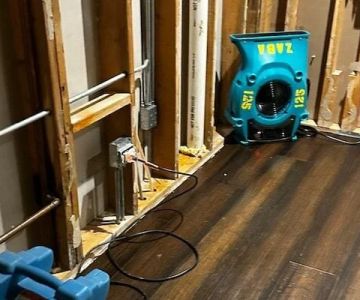
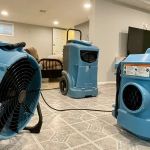
Drying may combine water extraction, dehumidification, controlled airflow, and specialized floor systems. Equipment should be sized and positioned from measurements, not pointed randomly at the most visible board.
The U.S. Environmental Protection Agency’s water-damage guidance emphasizes responding within 24–48 hours and cautions when using heat on hardwood floors. High heat can dry the top too quickly, damage finish or adhesive, and increase uneven movement while deeper layers remain wet.
Do not move or unplug restoration equipment without the provider’s approval. Keep doors, windows, and HVAC settings as directed because changing them alters the drying chamber. Request daily or scheduled moisture records and a defined drying goal.
Track cupping, gaps, and finish changes
Cupping means board edges are higher than centres, often reflecting a moisture difference through the board. Crowning means centres are higher. Boards can also buckle, lift, gap, stain, delaminate, or lose finish adhesion.
Photograph the same reference areas each day from the same angle. Note odour, sound underfoot, board movement, new gaps, finish whitening, and transitions into cabinets or walls. Do not repeatedly press or walk on distorted areas.
Some movement can lessen as moisture equalizes; some damage remains. Appearance during active drying is not a reliable final repair decision.
Decide on repair after stabilization
Wait until the floor and subfloor have reached documented, appropriate moisture conditions before sanding, refinishing, or replacing isolated boards. Sanding a cupped floor too early can create the opposite distortion after the underside dries.
Repair planning should consider water category, duration, species, construction, fastening or adhesive, finish, subfloor condition, mould, odour, staining, and the availability of matching material. A flooring professional and restoration contractor may need to coordinate.
Ask for a written conclusion: what dried in place, what was removed, final readings and reference readings, remaining damage, repair options, and warranty for the work.
Contamination, mould, and safety limits
This article is general information, not a water-category assessment or drying specification. Floodwater and sewage can contain biological and chemical hazards. Extensive contamination, visible mould, long wetting, strong odour, health-sensitive occupants, or inaccessible cavities require professional evaluation.
People with asthma, allergies, immune suppression, or other health concerns should follow medical advice about exposure. Never mix cleaning chemicals, and do not routinely apply bleach or antimicrobial products without an approved plan for the material and hazard.
Frequently asked questions
Can I use a heater to dry hardwood quickly?
Do not apply concentrated heat. Controlled drying should address the full assembly and be guided by measurements; excessive heat can worsen uneven movement.
Should I sand cupped boards right away?
No. Let the assembly stabilize and obtain moisture readings first. Early sanding can create permanent distortion later.
Why is the floor still wet underneath when the top feels dry?
Finish slows evaporation, while seams let water reach lower layers. Air movement over the top does not prove the subfloor is dry.
Can every hardwood floor be saved?
No. Contamination, delamination, buckling, mould, finish damage, long wetting, and repair economics can require partial or full replacement.
Next steps
Secure the source and electrical safety, document the water path, remove only manageable clean water, and call appropriate restoration, flooring, and insurance contacts. Require readings for the boards and subfloor, keep drying equipment in the approved configuration, and postpone cosmetic repair until the entire assembly is stable.
 Royal Restoration Pro4.0 (28 reviews)
 Basement Systems of Indiana4.0 (576 reviews)
 WOW 1 DAY PAINTING Northern Virginia4.0 (156 reviews)
 ConnReno4.0 (26 reviews)
 Rochester Painting Company4.0 (25 reviews)
 SERVPRO of North Central Mesa4.0 (48 reviews)
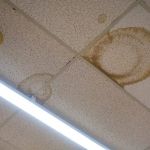 How to Handle Water Damage in Your Office Building’s Ceiling: A Comprehensive Guide
 How to Handle Water Damage From Basement Floods | Tips for Clean-up and Prevention
 Water Damage Restoration for Industrial Buildings
 Water Damage Repair for Subflooring Under Carpets
 How to Repair Water-Damaged Ceilings – A Comprehensive Guide
 Water Damage Restoration Techniques: From Drying to Sanitizing