
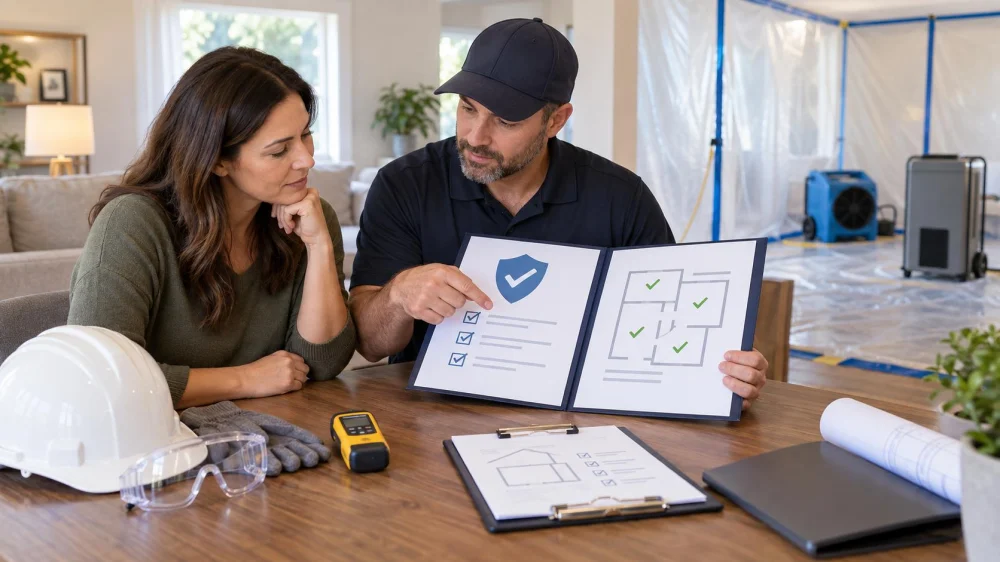
Water Damage Contractor Credentials: Insurance and Scope
On this page
- Quick answer
- Handle immediate safety first
- Verify the business identity
- Confirm insurance carefully
- Match qualifications to each task
- Separate emergency and planned scope
- Ask about subcontractors and access
- Understand payment and claim relationships
- Pause for warning signs
- Limits and important notes
- Frequently asked questions
- Sources and evidence notes
- Conclusion and next steps
Quick answer
Before authorizing water damage work, identify the legal business, verify any state or local licence required for the specific trade, and request current liability and workers' compensation insurance directly from reliable sources. Ask who will perform extraction, demolition, drying, mould-related, electrical, plumbing, and rebuilding work. Separate emergency stabilization from later restoration in writing. Confirm scope, rates, equipment, documentation, subcontractors, payment authorization, insurance communication, change orders, and responsibility for permits and completion records.

Kustom US Restoration / kustom restoration
1215 W Houston Ave Suite A, Gilbert, AZ 85233, USA
Handle immediate safety first
For electrical hazards, contaminated water, structural movement, fire, gas, or rapid flooding, keep people away and contact emergency services, utilities, or qualified professionals as appropriate. Do not delay reasonable loss prevention merely to complete a full procurement process.
Even during an emergency, ask what is being authorized now, the rate basis, who is entering the property, and when a written scope will follow. Photograph conditions only from a safe area.

Wizard Restorations Inc / puroclean of san fernando
Rancho CucamongaSan Bernardino CountyCalifornia
10245 8th St, Rancho Cucamonga, CA 91730, USA
Verify the business identity
- Legal business name and physical contact information.
- Names of the representative and site supervisor.
- Applicable contractor, trade, or remediation licences.
- Current registration status through official sources.
- Complaint or discipline information where publicly available.
- Who will sign the contract and receive payment.
Similar company names, wrapped vehicles, badges, and directory listings are not substitutes for an official identity check.
Confirm insurance carefully
Request evidence of general liability and workers' compensation appropriate to the work, and verify it through the insurer, agent, or official system rather than relying only on an emailed image. Check business name, policy dates, limits, exclusions, and whether subcontractors are covered.
Your property policy and the contractor's policy serve different purposes. Ask your insurer what notice, documentation, or vendor rules apply without assuming it guarantees payment.
Match qualifications to each task
Water extraction, structural drying, demolition, hazardous-material handling, mould-related work, plumbing, electrical, HVAC, contents treatment, and reconstruction can involve different training, licences, and permits. A general restoration credential does not authorize every regulated trade.
Ask who diagnoses and performs each part, which standard or protocol applies, and when an independent specialist is needed.
Separate emergency and planned scope
- Define the rooms, materials, and immediate source-control actions.
- List extraction, containment, cleaning, removal, drying, and monitoring.
- Identify equipment types, quantities, rates, and expected review.
- State exclusions and uncertain hidden conditions.
- Set change-order approval and spending limits.
- Describe completion criteria and documents.
- Quote reconstruction separately when practical.
Ask about subcontractors and access
Request the business names and roles of subcontractors, their credentials and insurance, who supervises them, and who pays them. Understand lien notices and payment procedures in your state.
Limit keys and access codes, protect unaffected rooms and valuables, log entries, and require identification. Revoke temporary access when the project ends.
Understand payment and claim relationships
Know whether you or the insurer is the customer, who owes amounts the insurer does not pay, whether benefits or claim rights are assigned, and what deposits, deductibles, financing, cancellation, and collection terms apply. Do not sign blank forms.
Ask the contractor to distinguish an estimate, authorization, invoice, direction-to-pay, and assignment. Seek legal or insurance guidance before transferring significant rights.
Pause for warning signs
Be cautious about pressure to sign immediately beyond necessary stabilization, unverifiable credentials, refusal to itemize rates, promises that insurance will pay everything, requests for unusual payment, blank authorizations, unexplained demolition, or reluctance to document moisture and equipment.
If safe stabilization is complete, take time to verify and compare. For suspected fraud, contact the insurer, payment provider, licensing board, or appropriate consumer authority.
Limits and important notes
Credential requirements vary by state, locality, trade, water category, contamination, building type, and scope. Certification, licensing, bonding, and insurance are different and none guarantees workmanship.
This is general US consumer guidance, not legal, insurance, environmental, health, or construction advice. Official regulators, the contract, insurer, qualified specialists, and actual loss conditions govern a specific project.
Frequently asked questions
Can my insurer choose the contractor?
Programs and rights vary. Ask what is required, what is optional, and who contracts with and pays the vendor.
Is a certificate of insurance enough?
It is evidence to verify, not a guarantee of coverage. Confirm status and details with a reliable source.
Should rebuilding be in the emergency contract?
It can be, but separating stabilization, drying, and reconstruction can make scope, pricing, and completion easier to review.
Sources and evidence notes
This article applies general contractor-verification, insurance, emergency-scope, subcontractor, payment, privacy, and restoration-documentation principles. State and local regulators, insurers, qualified professionals, written contracts, and actual site conditions determine a specific project's requirements.
Conclusion and next steps
Stabilize immediate hazards, then verify the business and each regulated trade. Put emergency work, rates, equipment, access, documentation, and change authority in writing. Retain credentials, insurance verification, daily records, approvals, invoices, and closeout documents in one loss file.
 Reliable Basement Finishing5.0 (60 reviews)
 PuroClean of Placentia0.0 (0 reviews)
 Coast Abatement Services4.0 (60 reviews)
 The Renovators4.0 (40 reviews)
 Orange Restoration Labs4.0 (46 reviews)
 CRACK-X of Merrimack Valley4.0 (49 reviews)
 Water Damage Contractor Credentials: Insurance and Scope
 Restoration Daily Drying Log: Readings, Equipment, and Changes
 Restoration Equipment Power: Plan Safe Connections
 Restoration Crew Access: Protect Keys and Privacy
 Property Damage Repair Estimate: Compare Scope, Not Price Alone
 Property Damage Recurrence Log: Track Weather, Timing, and Clues