
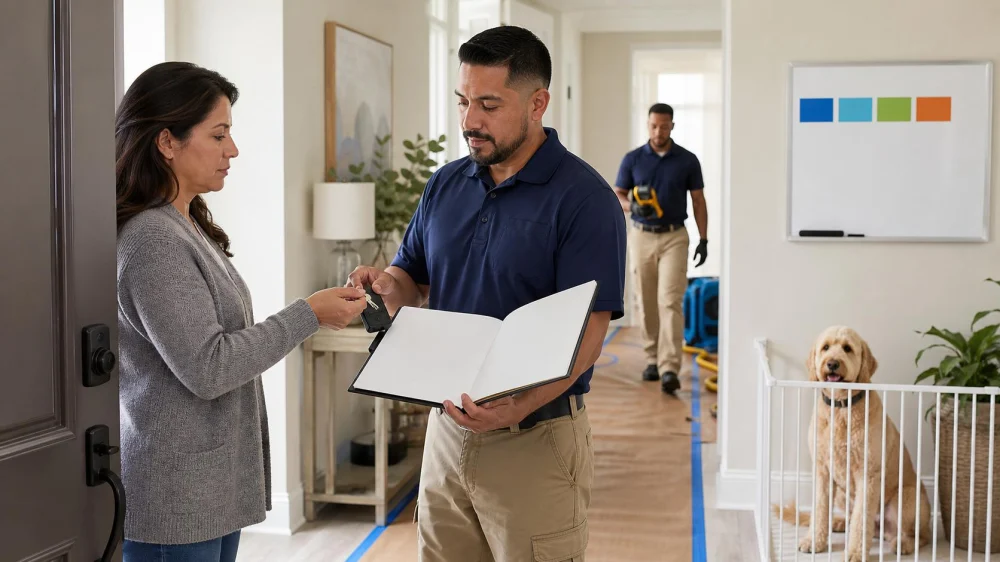
Water Damage Contractor Access: Plan Keys, Pets, and Updates
On this page
- Identify who needs access
- Create an entry plan
- Protect keys, codes, and alarms
- Manage pets and household members
- Define work zones and boundaries
- Prepare for daily monitoring
- Agree on update content and timing
- Handle unscheduled visits
- Document damage and belongings
- Close access after the project
- Contractor access checklist
Water damage work often requires repeated access for extraction, moisture monitoring, equipment checks, demolition, cleaning, and repairs. Visits may happen while the homeowner is at work or temporarily staying elsewhere. Without a clear plan, workers can be delayed at the door, pets can enter hazardous zones, and important changes may not reach the right decision-maker.
Set access rules with the restoration company before handing over a key or code. Identify approved people and hours, protect security information, separate work zones from private areas, and choose how daily updates will be documented. Immediate fire, electrical, structural, contamination, or medical danger still takes priority over routine access procedures.
SERVPRO of Pompano Beach / servpro of santa maria
Pompano BeachBroward CountyFlorida
2101 NW 33rd St #200a, Pompano Beach, FL 33069, USA
Identify who needs access
Ask the primary contractor for the company name, project manager, site supervisor, after-hours contact, and types of workers expected. Water damage projects may involve restorers, plumbers, electricians, hygienists, inspectors, adjusters, movers, and repair trades. Not everyone arrives on the same schedule or works for the same company.
Request advance notice of subcontractors and confirm how they identify themselves. Decide who in the household can approve entry and changes. The contractor should not assume a neighbor, tenant, doorman, or child can authorize access.

Wizard Restorations Inc / puroclean of san fernando
Rancho CucamongaSan Bernardino CountyCalifornia
10245 8th St, Rancho Cucamonga, CA 91730, USA
Create an entry plan
Write the permitted days, time windows, entrances, parking instructions, lockup steps, and contact method for arrival and departure. Note building rules, gate access, elevators, loading areas, and shared corridors. For a rental or managed property, coordinate with the appropriate owner or manager under the lease and applicable requirements.
Identify a backup if the primary contact cannot respond. Include emergency procedures for active leaking, equipment alarms, or newly unsafe conditions. Do not promise unrestricted entry when another resident, tenant, insurer, or authority must approve it.
Protect keys, codes, and alarms
Use the least access necessary. A temporary code or managed key safe can be easier to revoke than distributing permanent keys, but it must suit the property and security system. Avoid placing the full address on a loose key tag or sending a code in a large group message.
Record who receives each key or code and when it is returned or disabled. Explain alarm arming, required zones, camera notification, and any entry log without sharing unrelated passwords. If a key is lost or a code is exposed, follow the property security provider's guidance promptly.
Manage pets and household members
Keep pets completely separated from work zones, cords, containment, open doors, chemicals, wet materials, and equipment. A closed bedroom may be unsuitable if workers need access or noise causes distress. Consider a trusted caregiver, boarding arrangement, or safe off-site location.
Tell the contractor about children, older adults, mobility needs, home health equipment, remote work, or anyone who may not hear a knock or alarm. Do not leave a child or vulnerable person responsible for admitting workers. Confirm whether the property is safe to occupy and follow qualified relocation guidance.
Define work zones and boundaries
Walk safe, released areas with the project manager and identify affected rooms, equipment routes, storage, restrooms, utilities, and exits. Mark private or unaffected rooms that workers should not enter without new permission. Move valuables, medicines, financial papers, and fragile items where this can be done safely.
Do not enter contaminated, electrically unsafe, structurally unstable, or professionally contained areas to retrieve belongings. Ask the restoration team about a controlled retrieval or pack-out. Barriers and containment are safety systems, not privacy curtains that occupants can open between visits.
Prepare for daily monitoring
Restoration equipment may require regular readings, drainage checks, filter changes, or repositioning. Confirm the expected visit window, duration, rooms needed, and whether someone must be present. Ask what happens on weekends, holidays, or when severe weather limits travel.
Keep equipment routes clear and do not unplug, move, cover, or change devices. If access fails, tell the project manager promptly; missing a monitoring visit can affect drying decisions. The company should document readings and changes rather than relying on the homeowner to operate technical instruments.
Agree on update content and timing
Choose one primary communication channel and a regular update time. A useful update states who entered, when, which rooms were accessed, work performed, equipment added or removed, professional measurements, new findings, photos, decisions needed, cost or schedule changes, and the next visit.
Separate urgent alerts from routine summaries. Define which changes require written owner approval and who may approve them if the owner is unavailable. A photo alone is not a complete explanation of hidden damage; ask for the location, significance, options, and effect on scope.
Handle unscheduled visits
Do not admit an unknown person solely because they mention the claim or contractor. Verify through the established project manager using a known contact. Ask the visitor to wait outside while identity and purpose are confirmed, provided it is safe to do so.
For an urgent active loss, fire department, utility, law enforcement, or emergency building response may follow different access rules. Personal safety comes first. Afterward, document who attended and why, and notify the restoration and insurance contacts through official channels.
Document damage and belongings
Before routine work begins, photograph safe accessible rooms, belongings, and routes. Create an inventory for items moved, discarded, cleaned, or stored, with dates and destination. The contractor should follow the agreed authorization and documentation process for destructive work and disposal.
Respect worker privacy and ask before recording people. Security cameras should be disclosed where required and should not capture private conversations or restricted areas improperly. Keep project photos and reports in a secure folder separate from public social media.
Close access after the project
When monitoring and repairs end, collect keys, disable temporary codes, remove lockboxes, update alarm permissions, and confirm that doors and windows operate. Review the access log and ask about any outstanding return visit, inspection, warranty correction, or equipment pickup.
Do not close access before every approved worker and item has left. Get final documentation for equipment removal, remaining contents, storage, cleanup, repairs, and warranties. If permanent credentials were widely shared, consider changing them in consultation with the security provider.
Contractor access checklist
- List companies, supervisors, trades, and approved contacts.
- Write entry hours, doors, parking, and lockup steps.
- Track keys and use revocable codes where appropriate.
- Move pets and vulnerable occupants away from work zones.
- Define authorized rooms, routes, storage, and private areas.
- Confirm the monitoring schedule and failed-access process.
- Require daily written updates and change approvals.
- Verify unexpected visitors through known contacts.
- Inventory moved, cleaned, stored, and discarded items.
- Revoke access only after final visits and removal are complete.
A good contractor access plan keeps restoration moving without treating the property as an open worksite. Give the right people limited, documented access; protect occupants, pets, keys, and private spaces; and make each visit visible through a consistent update. When the project ends, close every temporary access route as carefully as it was opened.
 Radar Restoration LLC4.0 (34 reviews)
 SERVPRO of Middletown4.0 (33 reviews)
 Ridgeline Integrated Solutions5.0 (12 reviews)
 Renew Restoration and Cleaning Service4.0 (27 reviews)
 Restoration Roofing Specialists5.0 (25 reviews)
 Sunbelt Contractors4.0 (7 reviews)
 Water Damage Restoration for Hotels and Hospitality Spaces
 Water Damage Repair for Bathroom Flooring and Tile in the USA
 How to Clean Water-Damaged Carpeting and Area Rugs
 How to Manage Water Damage from Mold Growth
 How to Dry Out Water-Damaged Rugs Quickly
 How to Repair Water Damage Around Interior Installations